


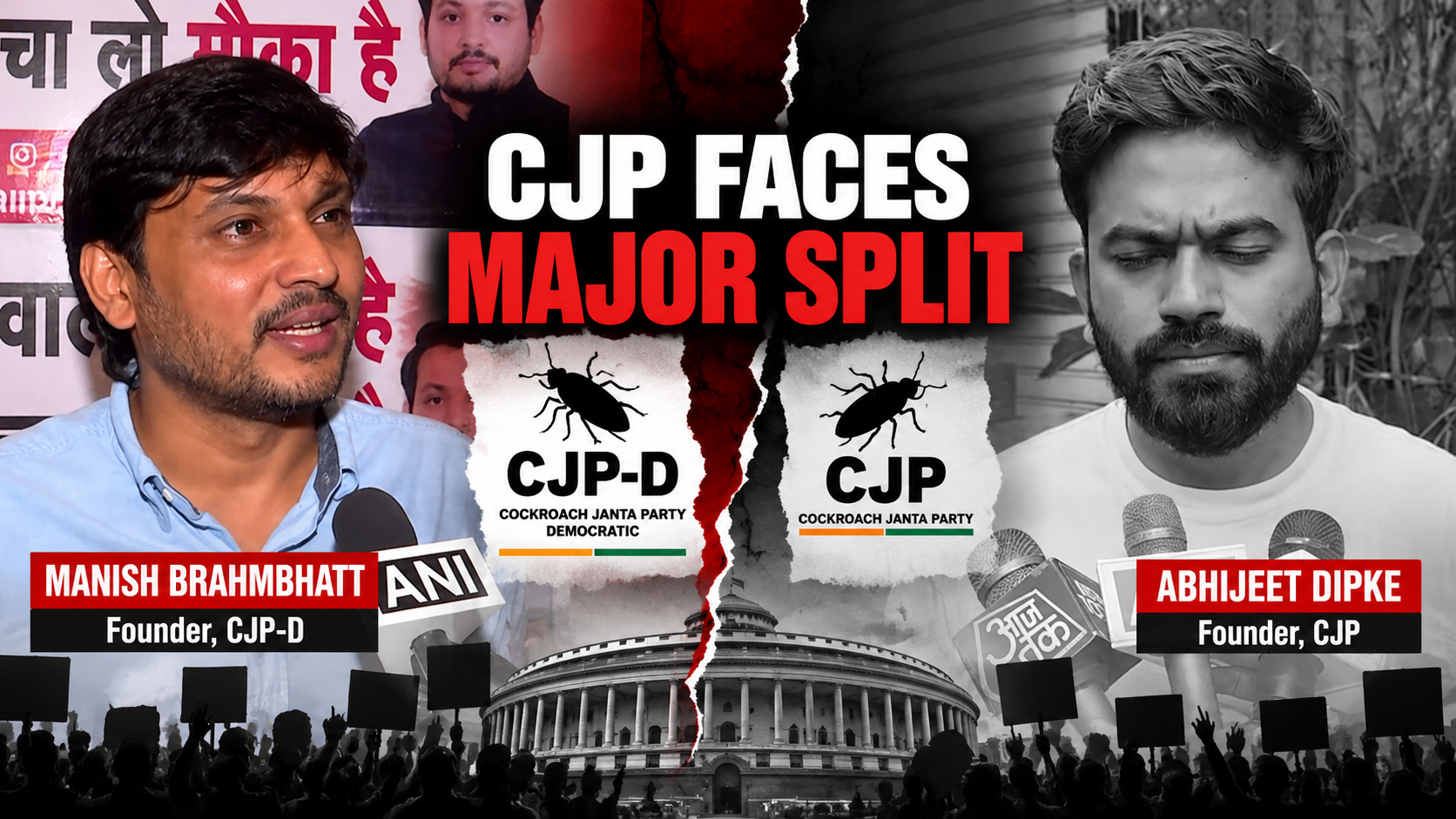
Cockroach Janta Party Faces Major Split: Rebel Group Accuses Leadership of Losing Its Democratic Character
New Delhi, September 5, 2026: The Cockroach Janta Party is facing growing questions over its internal democracy after former volunteer Manish Brahmbhatt launched a rival faction, the Cockroach Janta Party-Democratic.
The breakaway group says its objective is to restore transparency and greater participation by volunteers in decision-making.
Brahmbhatt has accused the original CJP leadership of sidelining grassroots workers and concentrating important decisions among a limited group of leaders. His allegations have opened a new debate about whether CJP’s internal functioning matches the democratic principles it promotes publicly.
Transparency Becomes the Central Issue
CJP’s public appeal has largely rested on its image as a youth-led movement challenging conventional politics.
That image is now being tested from within.
Brahmbhatt has alleged that volunteers were not given sufficient involvement in organisational decisions. He has also raised questions about the way meetings and internal discussions were conducted.
These remain allegations from the breakaway faction and have not independently established wrongdoing by CJP’s leadership.
Nevertheless, the accusations have created an unusual situation: a movement campaigning for accountability is now being asked to demonstrate accountability within its own organisation.
CJP Leadership Faces Pressure
The dispute also puts founder Abhijeet Dipke under greater scrutiny.
Dipke’s leadership has been central to CJP’s explosive growth since the movement began. Boston University’s College of Communication has separately described him as a graduate who helped turn the original “cockroach” idea into a large online movement.
But rapid growth can also create organisational tensions.
The formation of CJP-D suggests that some activists believe the movement’s original grassroots model has been weakened by its expansion.
Can CJP Rebuild Trust?
The immediate challenge for CJP is not simply the existence of a rival faction.
It is whether the organisation can demonstrate that its internal decision-making is transparent enough to withstand criticism from former members.
If CJP succeeds in addressing those concerns, the split may remain limited. If more volunteers follow Brahmbhatt, however, the dispute could develop into a much broader organisational crisis.
For a movement that has built its reputation on demanding accountability from others, its own internal democratic practices are now under the spotlight.