


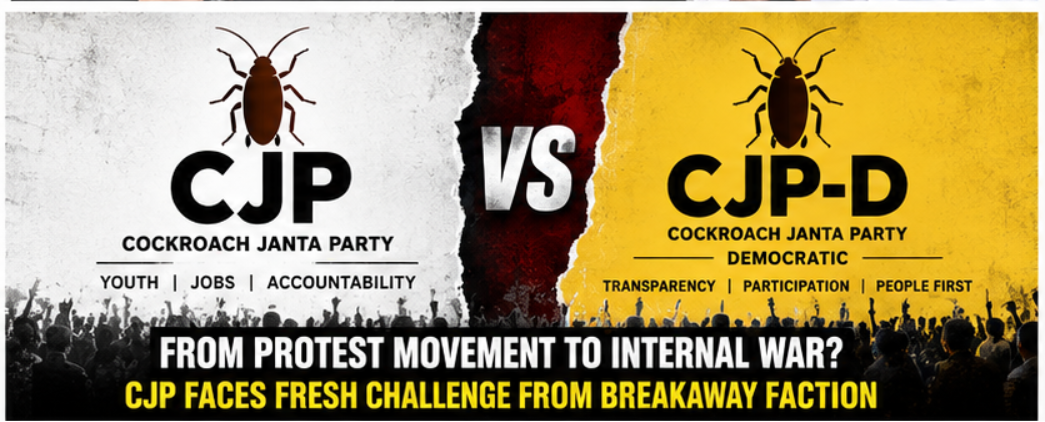
From Protest Movement to Internal War? CJP Faces Fresh Challenge From Breakaway Faction
New Delhi, September 5, 2026: The Cockroach Janta Party’s rapid rise has been followed by an unexpected development: a fight over who represents the movement’s original political vision.
Former CJP worker Manish Brahmbhatt has launched the Cockroach Janta Party-Democratic, turning what was previously an internal disagreement into an open organisational challenge to founder Abhijeet Dipke.
The rival faction says it wants to preserve grassroots participation and transparency, while Brahmbhatt has accused the existing leadership of moving away from its student-led origins.
Two Versions of the CJP Story
The dispute effectively creates two competing versions of the CJP project.
The Dipke-led organisation emerged from an online campaign that transformed a controversial reference to unemployed young people into a youth movement focused on education, employment and political accountability.
Boston University’s own account of Dipke’s role describes how his social-media post asking what would happen if “all the cockroaches” came together rapidly developed into the Cockroach Janta Party.
But Brahmbhatt’s breakaway faction argues that the movement has subsequently changed direction.
He has accused the current leadership of sidelining activists and becoming too closely connected to political interests.
Allegations of Political Influence
One of the most serious accusations made by the rebel faction is that the CJP leadership has become associated with the Aam Aadmi Party.
Brahmbhatt has referred to the Dipke-led organisation as “Team Kejriwal”, an allegation that CJP’s leadership disputes.
The accusation is particularly significant because CJP has presented itself as an independent youth movement rather than an extension of an established political party.
There is currently no established finding that CJP is formally controlled by AAP. The political connection remains an allegation made by critics and the breakaway faction.
The Bigger Question
The CJP split raises an important question for the movement’s future: will supporters remain loyal to the original leadership, or will a section of the grassroots network follow the new democratic faction?
CJP’s extraordinary online growth gave it influence in a remarkably short period. The internal dispute could now provide its first real test of organisational strength.
What began as a movement challenging the political establishment is now dealing with a political battle of its own.
The CJP’s biggest challenge may no longer be its opponents — it may be keeping its own house together.