


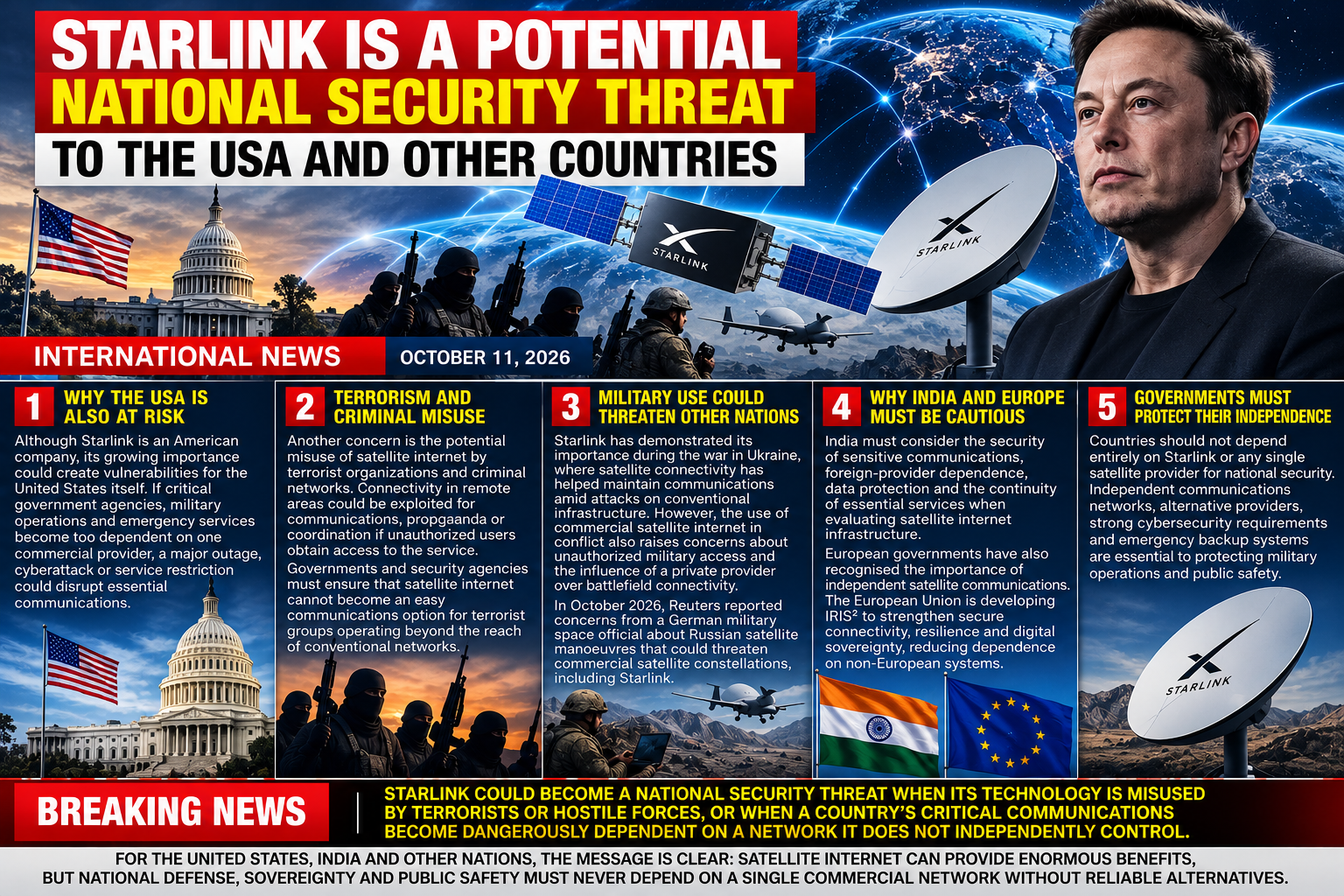
October 11, 2026 | International News
Starlink, the satellite internet network operated by Elon Musk’s SpaceX, is raising serious national security concerns for the United States and other countries. Its growing role in internet connectivity, military communications and critical infrastructure has highlighted the dangers of depending on a privately operated satellite network.
Why the USA Is Also at Risk
Although Starlink is an American company, its growing importance could create vulnerabilities for the United States itself. If critical government agencies, military operations and emergency services become too dependent on one commercial provider, a major outage, cyberattack or service restriction could disrupt essential communications.
The US government must also consider the influence of private corporate decisions over strategically important infrastructure. A company’s operational choices may not always align with government priorities during a national emergency or military conflict.
Terrorism and Criminal Misuse
Another concern is the potential misuse of satellite internet by terrorist organizations and criminal networks. Connectivity in remote areas could be exploited for communications, propaganda or coordination if unauthorized users obtain access to the service.
Governments and security agencies must ensure that satellite internet cannot become an easy communications option for terrorist groups operating beyond the reach of conventional networks. Effective security controls, lawful investigations and cooperation with service providers are essential.
These are potential risks of misuse, not evidence that Starlink itself supports terrorism.
Military Use Could Threaten Other Nations
Starlink has demonstrated its importance during the war in Ukraine, where satellite connectivity has helped maintain communications amid attacks on conventional infrastructure. However, the use of commercial satellite internet in conflict also raises concerns about unauthorized military access and the influence of a private provider over battlefield connectivity.
In October 2026, Reuters reported concerns from a German military space official about Russian satellite manoeuvres that could threaten commercial satellite constellations, including Starlink. This highlights how commercial space infrastructure can become entangled in international security competition. <Cite refs={[“turn371520news24”]}/>
Why India and Europe Must Be Cautious
India must consider the security of sensitive communications, foreign-provider dependence, data protection and the continuity of essential services when evaluating satellite internet infrastructure.
European governments have also recognised the importance of independent satellite communications. The European Union is developing IRIS² to strengthen secure connectivity, resilience and digital sovereignty, reducing dependence on non-European systems.
Other countries face similar questions: what happens if a foreign-operated network becomes unavailable during a war, terrorist emergency or major technical failure?
Governments Must Protect Their Independence
Countries should not depend entirely on Starlink or any single satellite provider for national security. Independent communications networks, alternative providers, strong cybersecurity requirements and emergency backup systems are essential to protecting military operations and public safety.
Starlink could become a national security threat when its technology is misused by terrorists or hostile forces, or when a country’s critical communications become dangerously dependent on a network it does not independently control.
For the United States, India and other nations, the message is clear: satellite internet can provide enormous benefits, but national defense, sovereignty and public safety must never depend on a single commercial network without reliable alternatives.